Showing posts with label SAP BASIS training. Show all posts

Sunday, 26 November 2017

Online SAP Training | What is the Best SAP Module to Learn Based on Educational Background

The SAP training is becoming more and more competitive as companies across the globe with their business and IT systems utilizing SAP solutions offer multiple job opportunities. With the growth of the competitive job market the curve of SAP consultants is changing drastically. But the only question was which SAP module has to be chosen for career.
SAP Trainings Online is the one stop destination for all SAP courses training providing all SAP technical and SAP functional courses with industry standards. We have team of certified professionals who are dedicated to impart technology into life.
SAP is a business leader in enterprise software solutions aimed at data management and structured work in organizations.
Factors to choose right SAP module
Before applying for the SAP training course, take a moment and go through the factors that can help you choose the right SAP program for you. Have a look.
Choose According to your background
First step towards SAP certified professional would be dipping into one’s academic background and work experience. The existing SAP modules are domain specific, therefore; one need to choose the one that fits the required domain. One will have to ask questions such as “What’s your domain?” “How much experience are you having in your domain?” to aid one in choosing the desired SAP course easily.
The Career goal  This is frequently the most overlooked  although an essential factor in deciding the module of choice. Before selecting any SAP module one needs to recognize whether one's passion, aptitude, and career goals in completion of SAP course.
The educational background of professional plays a large role in the selection of the SAP module in a career. The educational background makes it easier for a professional to comprehend business processes and other related traits involved in the field which has been learned during the academic acquisition of knowledge. It is challenging for process comprehension and understanding amongst such disparate team members, even taking up an inordinate amount of time. Therefore the educational aspect is of paramount importance in the selection of a SAP module. Given below are some of the most popular SAP modules used by companies:
SAP Simple Finance or SAP S/4 HANA Finance
SAP Human Capital Management (HCM)
SAP Materials Management (MM)
SAP Production Planning (PP)
SAP Sales and Distribution (SD)
SAP Financial Accounting and Controlling (FICO)
SAP BASIS
SAP Quality Management (QM )
SAP BASIS
Basis is a set of programs and tools that act as an interface with Database, Operating system, Communication protocols and business applications (such as FI, CO, MM, etc). Full form of BASIS is "Business Application Software Integrated solution". See SAP BASIS training for more info.
SAP BASIS administrators not only make sure all SAP components & applications can communicate with each other, but do so with no end user or backend processing performance degradation. Issues continuously crop up in any technical layer of a SAP landscape and it’s up to SAP Basis support to keep the enterprise cloud, database and application healthy. Basis administrators install updates, monitor the system for errors and tweak SAP to be faster and more reliable.
SAP Simple Logistics
With the introduction of SAP Simple Logistics, has turned out from delivering products to delivering outcomes with simple finance the first suite built on SAP HANA, we are seeing how simple it is to run in a digital economy. With the release of simple logistics we can expect more innovations to bring to business. There is more demand for SAP Simple Logistics training.
SAP Financial Accounting and Controlling
This module deals with the management of financial transactions within organizations. This Financial Accounting module aids employees in the management of data involved in any enterprise and financial transactions in a unified system. This module is highly flexible and functions really well in almost any form of economic situation. This module’s functioning is geared towards handling all sorts of reporting needs. Controlling focuses on providing support in terms of planning, reporting and monitoring operations at the enterprise level.  This module involves methods to look at and organize costs needed for financial reporting. Learn more from SAP FICO training. 
Who can avail the course according to educational background,
If one has been studying Managerial Accounting, Chartered Accountancy (CA), Chartered Institute of Management Accounts (CIMA), Association of Chartered Certified Accountants (ACCA) then SAP CO comes greatly recommended.
SAP Sales and Distribution (SD)
The SD module greatly augments inventory control and management. This module also comprises of master data, system configuration and transactions. A few of the sub-elements of SAP SD module are sales support, shipping, master data, sales, billing, transportation, sales information system, credit management and so on. Learn from SAP SD training.
The scope for advancement from this module onwards can be quite considerable using SAP Hybris and SAP CRM modules (SAP Trainings Online provides SAP CRM training). A major course elective in Distribution techniques, Channel Management, Sales Management, Marketing means a SAP SD module is meant for you.
SAP Production Planning (PP)
The module collaborates with Sales, Master Data, Operations Planning, Product Cost Planning, Material Requirements Planning, Distribution Resource Planning, Kanban and so on and so forth while working towards production management in organizations. Learn in detail concepts from SAP PP training.
SAP Materials Management (MM)
This module deals with the management of materials needed, processed and generated in organizations. Several types of procurement processes are to be managed within this system. See what MM dealt with from SAP MM training. If a candidate has been studying Supply Chain Management with Procurement and Logistics, Inventory Management, and Storage techniques, then this module would be a great choice. After mastering this module one would have gained knowledge and experience in SAP MM.
SAP Quality Management (QM)
The quality management module aids enterprises in speeding up business by an adoption of a structured and functional manner of managing quality in various processes. This module collaborates between audit management, control, notification, inspection, planning, production and even procurement and sales.
For candidates who have taken up studies in Total Quality Management, Statistics, Chemical Engineering and Pharmacy studies, this SAP QM training is considered to be useful.
SAP Human Capital Management (HCM)
This module focuses on enhancing the work process and data management within HR department of organizations. This includes the processes involved from the time a person is hired to evaluate an individual’s performance to managing promotions, compensations, handling and management of payroll and other related activities.
For candidates who have been studying Human Resource, Personnel Management, Comparative Management, and Organizational Management will find this SAP HCM training to be useful to add to their existing skill set.
There are many other modules in SAP; each and every module is different and unique in its own way. They are;
SAP Netweaver
SAP PM (Plant Maintenance)
SAP BO (Business Objects)
SAP BI (Business intelligence) and many
SAP is used by each and every sector now a day’s giving the scope for job opportunities. Some of the areas where SAP software used are
  • Banks
  • Retail
  • Industry
  • Telecommunications
  • Consumer Goods
  • Automotive Industry
  • Media
  • Transport and Logistics
SAP Consultants
An astronomically high demand, a diverse set of job offers and incredible salaries – all point toward how sought-after SAP professionals are in the current market. Increasing amount of companies to utilize SAP software. Or the simple of the fact that most enterprises have lapped up the concept of SAP software through extensive purchasing of said software has contributed to the widespread success of SAP. SAP-skills are highly useful in almost all existing positions today: Marketing, Controlling, Human Resources and a whole lot more. It is important to remember that every business process can be or is already represented in a SAP System.
Conclusion
SAP has been providing immense opportunities for those who have well-defined career goals. But before applying to any SAP module, it is advisable to take some time and weigh the reasons why one would want to go for a particular module. Online courses for SAP that are offered by SAP Trainings Online are of great help to get you where you want to go in your career. They are bound to impart the necessary amount of detailed knowledge and practically based hands-on usage of SAP modules at the time of the candidate’s choosing.

Saturday, 25 November 2017

Online SAP BASIS Training | SAP BASIS Patch Management

Basis is a set of programs and tools that act as an interface with Database, Operating system, Communication protocols and business applications (such as FI, CO, MM, etc). Full form of BASIS is "Business Application Software Integrated solution". Learn SAP BASIS training from SAP certified professionals by SAP Trainings Online.
In SAP system, a patch is used to fix a bug. There are different types of patches that can be used in SAP system. All patches start with SAPK followed by patch type.
The following are the four different types of patches:
  • ABAP (SAPKA620XXXX)
  • BASIS (SAPKB620XXXX)
  • HR (SAPKE470XXXX)
  • APPLICATIONS (SAPKH470XXXX)
SMP provides correction in form of patches. It may contain corrections similar to SAP notes, ABAP programming (Learn ABAP programming from SAP ABAP training by experts from SAP Trainings Online).  It helps to avoid Runtime error and dumps. You can check logs at SPAM. Sometime leaving the TR unreleased caused the issue or some manual correction is required.
In that case we cannot apply sap notes (even if we find them at OSS) as we are stuck in SPAM error phase.  Also in backend user\sap\trans\log and temp file contains the logs for error.
A patch follows this structure — SAPKA <Rel><No>
Patches are also called support packs and they should be applied in the following sequence:
  • BASIS (SAPKB620XXXX)
  • ABAP (SAPKA620XXXX)
  • HR (SAPKE470XXXX)
  • APPLICATIONS (SAPKH470XXXX)
Support packages and add-ons
As the name suggests, support packages are used to fix the bug and to improve the quality of SAP system. Support package implementation and administration is done with Transaction Spam (Support Package Manager). Each support package is valid for one release and Support Package Manager ensures that all support packages are applied in a specified order.
Support packs are applied in the above mentioned order — Basis > ABAP > HR > Applications. It is not necessary that Basis and ABAP patch levels should be same but SAP recommends that they should be at the same level. Generally, Basis and ABAP should be applied together however to apply one first, it should be Basis.
All support packs are applied with client 000. Support packages should be imported at regular intervals to avoid errors and to keep system landscape up to date.
There are different types of support packages available:
SPAM Update − A SPAM Update contains updates and improvements to Support Package Manager (SPAM) and Add-On Installation Tool.
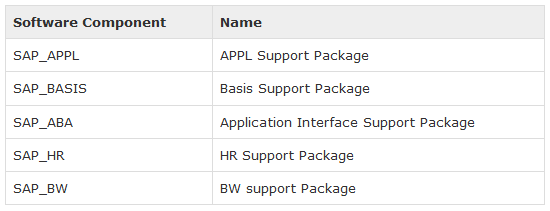
Component Support Package − This contains improvement for one software component such as SAP Basis, SAP HR or SAP APPLICATIONS and to update repository and dictionary objects.
The following table shows some naming conventions for Support Packages:
Conflict Resolution Transport − This is used to adjust the support packages on add on. A CRT for one release also contains adjustment for earlier releases of this add-on.
Requirements to implement support package
A support package is always implemented on client 000 and user should have an authorization equivalent to DDIC or SAP.
To implement a support package, use transaction code — SPAM. You can check if any previous package is in progress or is incomplete. If there is an incomplete support package, you can’t proceed with the implementation of a new one.
About SAP BASIS Online Training
SAP Trainings Online is a deceptively simple e-learning and SAP training authoring solution. Create super-effective training content and deliver courses via Virtual and implant in existing systems. It is very important for BASIS consultant to have hands on experience on live servers. It is right to have training because every scenario could not be created just by installing SAP. We provide training in many countries India, USA, UK, Canada, Australia, and New Zealand.
Register with us for free demo: www.saptrainingsonline.com/student-registration
For more details visit: www.saptrainingsonline.com
Email: contact@saptrainingsonline.com
Contact: India +91 9052775398 USA +1315282580

Wednesday, 8 November 2017

SAP BASIS Online Training | SAP ERP Introduction

SAP is the world leader in enterprise applications in terms of software and software-related service revenue. Based on market capitalization, it is the world’s third largest independent software manufacturer supporting all sizes of industries helping them to operate profitability, grow sustainably and stay ahead of the competition in the market.
What is ERP?
Enterprise Resource Planning (ERP) is a software that is built to organizations belonging to different industrial sectors, regardless of their size and strength.
If you are new to SAP and want to take SAP BASIS training online course, join SAP Trainings Online.
The ERP package is designed to support and integrate almost every functional area of a business process such as procurement of goods and services, sale and distribution, finance, accountings, human resource, manufacturing, production planning, logistics & warehouse management.
Business process integration
Every business, regardless of the industry they belong to, require connected systems with efficient information flow from one business process to another. Business Process Integration (BPI) plays an important role in overcoming integrating challenges that allows organizations to connect systems internally and externally.
Business Process Integration (BPI) allows:
  • Automation of business processes,
  • Integration of systems and services,
  • Secure sharing of data across numerous applications, and
  • Automation of management, operational, and supporting process.
The following illustration shows an overview of various business processes running in an enterprise and how they are integrated.
Evolution of ERP
During early phases of development, integrated solutions were designed for particular process areas such as:
Material Management − the integrated system was known as Material Requirement Planning (MRP)
Manufacturing − the integrated system was known as Manufacturing Resource Planning
However none of the integrated systems came with a complete solution for an organization covering major business process areas. In early 1990’s, the Gartner Group first used the acronym ERP. By mid–1990’s, ERP systems addressed all the core enterprise functions.
Functions of ERP
An ERP system typically performs the following functions:
  • Supports the integrated business process inside the organization.
  • Improves capital planning and helps in executing organizational plans and strategies.
  • Helps speed up the decision-making process over the analysis of accurate data.
  • Helps extend the business network to wider domains, expanding the products and services to reach more customers, suppliers, and partners.
  • Identifies operational risks to improve governance.
  • Provides protection against organizational data breaches and security threats to leakage of information.
  • Makes the organization adaptable to the rapid changes in the business process according to the needs.
  • Gives long-term profit by providing means to increase the customer base.
Functional areas
ERP is a business management software is usually a suite of integrated applications that a company can use to collect, store, manage, and interpret data from many functional areas including:
Financial Accounting − Deals with financial transactions and data.
Human Resource − Deals with information related to employee of an organization.
Customer Relationship Management − Deals with capturing and managing customer’s relationship, facilitating the use of customer experience to evaluate the knowledge database.
Sales and Distribution − Deals with order placement, delivery, shipment and invoicing.
Logistics and Warehouse Management − Deals with storage of products and shipment.
Manufacturing and Material Management − Deals with the production and production planning activities.
Supply Change Management − Deals with the movement of products, storing, managing, and controlling supplies.
Advantages of ERP
By integrating the business processes, the ERP offers the following advantages:
  • Saves time and expenses.
  • Allows faster decision-making by the management, utilizing the data and reporting tools designed in the systems.
  • Single data source and sharing of data among all the units of an organization.
  • Helps in tracking every transaction that takes place in an organization, from starting till end.
  • Provides synchronized information transfer in between different functional areas such as sales, marketing, finance, manufacturing, human resource, logistics, etc.
Disadvantages of ERP
It is not always easy to incorporate ERP in an organization. ERP suffers from the following drawbacks:
  • Sometimes business processes critical to an organization are to be re-engineered to align them with an ERP solution.
  • Cost of complex integration can be very high.
  • Switching from one ERP solution to another increases the implementation cost even further.
  • End-users are to be trained for their daily operations.
  • Customization is not preferred.
ERP Packages
Many companies develop and implement various ERP packages according to their budget and requirements to help them meet their business needs and run their business efficiently.
SAP Trainings Online is a unique SAP training platform which provides learners with real time project and case studies included in course content. SAP Trainings Online designed SAP BASIS training program based on present day industry requirements which makes the learners future ready and strengthens you to go challenging with industrial demands. We provide training in many countries India, USA, UK, Canada, Australia, New Zealand.
Register with us for free demo: www.saptrainingsonline.com/student-registration
For more details visit: www.saptrainingsonline.com
Email: contact@saptrainingsonline.com
Contact: India +91 9052775398 USA +13152825809

Tuesday, 7 November 2017

SAP BASIS Training | SAP BASIS – Remote Function Call

What is RFC?
For business applications, it is necessary to communicate and exchange information (in pre-defined formats) with other systems. Hence, there are well defined mechanisms to enable this communication. SAP has also provided us with such mechanism called RFC, which stands for 'Remote Function Call'.
To communicate between SAP systems, there is a need to define a mechanism. One of the most common ways is to define Remote Function Call (RFC Connection) between two systems. By creating a trusted RFC connection between two systems, it allows you to create trusted-trusting relationship between systems wherein, you can communicate and exchange information and data.
There are different types of trusted RFC connections.
  • A calling interface for ABAP Programs (See SAP ABAP training for more info about ABAP)
  • A calling interface for Non-SAP programs.
Basis is a set of programs and tools that act as an interface with Database, Operating system, Communication protocols and business applications (such as FI, CO, MM, etc). Full form of BASIS is "Business Application Software Integrated solution". (Develop career with SAP BASIS training by experts).
Functions of the RFC interface:
Converting all parameter data to the representation needed in the remote system.
Calling the communication routines needed to talk to the remote system.
Handling communications errors, and notifying the caller, if desired (using EXCEPTIONS parameter of the CALL FUNCTION).
RFC is a SAP protocol to handle communications between systems to simplify the related programming. It is the process of calling a function module which is residing on a different machine from the caller program. RFCs can be used to call a different program on the same machine as well, but usually, it is used when 'calling' and 'called' function modules/ programs are running on separate machines.
Details about RFC
  • SAP Uses CPIC (Common Programming Interface for Communication) Protocol to transfer data between Systems. It is SAP Specific protocol. Remote Function Call (RFC) is a communications interface based on CPI-C, but with more functions and easier for application programmers to use.
  • RFC connections can always be used across the entire system. This means that an RFC connection you have defined in client 000 can also be used from client 100 (without any difference).
  • RFC is the protocol for calling special subroutines (function modules) over the network. Function modules are comparable with C functions or PASCAL procedures. They have a defined interface through which data, tables and return codes can be exchanged. Function modules are managed in the R/3 System in their own function library, called the Function Builder.
  • You maintain the parameters for RFC connections using transaction SM59. The R/3 System is also delivered with an RFC-SDK (Software Development Kit) that uses extensive C libraries to allow external programs to be connected to the R/3 System.
  • The only difference between a remote call of a function module to another server and a local call is a special parameter (destination) that specifies the target server on which the program is to be executed.
RFC Advantages
RFC helps to reduce the efforts of programmers, by letting them avoid the re-development of modules and methods at remote systems. It is capable enough to:
  • Convert the data into the format understandable by the remote (target) system.
  • Convert the data into the format understandable by the remote (target) system.
  • Call up certain routines which are necessary to start communication with the remote system.
  • Handle errors that might occur in the process of communication.
Types of RFC
Synchronous
Requires both the systems (client and server) to be available at the time of communication or data transfer. It is the most common type and is required when the result is required immediately after the execution of sRFC.
sRFC is a means of communication between systems where acknowledgments are required. The resources of the Source System wait on the target system and ensure that they deliver the message/data with ACKD. The Data is consistent and reliable for communication.
Used for
For communication between systems
For communication between SAP Web Application Server to SAP GUI
Asynchronous
It is communication between systems where acknowledgments are not required (it is similar to postcard delivery).It doesn't require both the systems to be available at the time of execution and the result is not immediately required to be sent back to the calling system.
The Source System resource does not wait for the target system as they deliver the message/data without waiting for any acknowledgment. It is not reliable for communication since data may be lost if the target system is not available.
Used for
For communication between systems
For parallel processing
Transactional
It is a special form of aRFC. Transactional RFC ensures transaction-like handling of processing steps that were originally autonomous. Transactional RFC is an asynchronous communication method that executes the called function module in the RFC server only once, even if the data is sent multiple times due to some network issue. The remote system need not be available at the time when the RFC client program is executing a tRFC. The tRFC component stores the called RFC function, together with the corresponding data, in the SAP database under a unique transaction ID (TID). tRFC is similar to aRFC as it does not wait at the target system (Similar to a registered post). If the system is not available, it will write the Data into aRFC Tables with a transaction ID (SM58) which is picked by the scheduler RSARFCSE (which runs for every 60 seconds).
Interested to learn SAP BASIS join, SAP Trainings Online is a deceptively simple e-learning and course authoring solution. Create super-effective training content and deliver courses via Virtual and implant in existing systems.
Try SAP BASIS Demo Class today! To register Click Here
For more details visit: www.saptrainingsonline.com
Email: contact@saptrainingsonline.com
Contact: India +91 9052775398 USA +13152825809 

Tuesday, 24 October 2017

SAP BASIS Online Training: Future Scope of SAP BASIS | SAP BASIS Salary Trends

What is SAP BASIS?
SAP BASIS is specified to administer the SAP system which is responsible for performing all system administration activities like installation, configuration, load balancing and performance of SAP applications running on programming platforms JAVA and SAP ABAP (Learn how to program SAP system using SAP ABAP training course).
SAP BASIS is business application software system consists of middle ware programs and tools which offer applications to the operative systems in practical mode. It includes RDBMS, GUI, and client server architecture.
Important responsibilities of SAP BASIS administrator includes:
  • System installation and configuration
  • Maintaining load balancing on servers
  • Monitoring performance management of different components
  • Managing system interfaces and integrations with servers
  • Managing servers and different services
SAP BASIS can lay an interface to connect and communicate with other SAP modules like finance accounting, production planning (SAP PP), sales and distribution (Learn SAP SD), SAP EWM and many other SAP modules by integrating each other.
There is an extensive demand for SAP BASIS training across the world. SAP Trainings Online provides SAP training courses with collective online sessions. Here you can learn every basic steps of SAP BASIS and you can also learn about SAP dispatcher and its uses. This BASIS training is concentrated on various classifications. At the primary stage of the training the candidates gets an overview with the core concepts of the BASIS module. During this, the concepts of SAP R/3 Client, Architecture and Server Expertise are taught. Our SAP Basis training includes the subject of different services including staging, database and application services.

SAP BASIS Salary Trends

Average SAP BASIS Salary is increasing and is much better than other products.
Coming to SAP BASIS training, it includes subject of different services like database, staging and application services and we laid special emphasis on SAP R/3 administration in relation with client. To be precise learners can implement and learn how to form a client, how to drib a client and create a client duplicate for all primitive transfer in and transfer out purpose. 
To join SAP BASIS training at SAP Trainings Online participants are suggested to have:
  • Basic knowledge of operating system administration
  • Network management
  • Database administration
The demo class on our SAP Basis online training shall be provided beforehand of starting the SAP Basis training. Click Here for free demo.
For training needs visit: www.saptrainingsonline.com
Email: contact@saptrainingsonline.com
Contact: India +91 9052775398 USA +13152825809

Saturday, 14 October 2017

Career in SAP BASIS technology | SAP BASIS Online Training

SAP BASIS refers to the administration of SAP system that includes activities like installation and configuration, load balancing, and performance of SAP applications running on Java stack and SAP ABAP. This includes the maintenance of different services related to database, operating system, application and web servers in SAP system landscape and stopping and starting the system.
The key responsibilities of SAP Basis Administrator include:
  • System installation and Configuration
  • Load balancing on servers
  • Performance management of different components
  • Managing interfaces and integration with servers
  • Managing servers and different services
With the help of SAP BASIS, different SAP modules like Finance Accounting, Production Planning, Sales and Distribution (Learn what sales deals with in SAP from SAP SD training by experts), SAP EWM and other modules can integrate and communicate with each other.
SAP Basis supports the installation and configuration of SAP applications on different operating systems like Windows, Unix, AS/400, etc. and different databases like SQL Server (want to learn from experts register for SQL server training), Oracle, IBM DB2 for back end database.
Knowledge required to become SAP BASIS Consultant
Have a strong technical background (and I mean STRONG) as you be expected to know UNIX, AIX, LINUX, WINDOWS, ORACLE, MSSQL, DB2/DB6, JAVA, and all the combination in between them. Also you should know your HARDWARE really well and you need to be skilled on NETWORKING, switching and routing.
Scope of SAP BASIS Consultants in IT organization
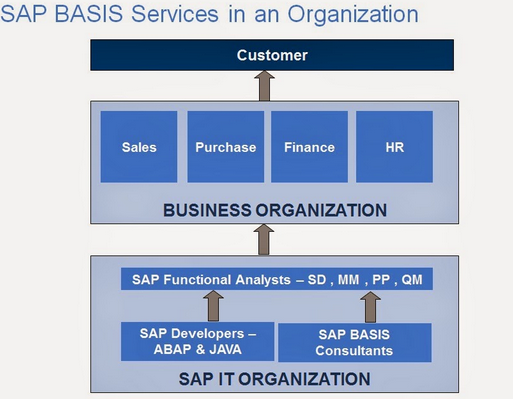
SAP consultants who design, build and manage the SAP environment are termed as BASIS consultants. They are the SAP Technical architects in the IT organization.
SAP consultants possess the skills required to administer and configure SAP specific settings in an IT landscape. They are part of a larger organization which may run a landscape consisting of several SAP and Non-SAP applications.
Prerequisites to start career in SAP BASIS
Basic knowledge of operating system administration, network management and database administration.
With Reference to above Diagram SAP Developers and Basis Consultant are the base for SAP support framework .They provide support to functional consultant SD, MM, etc. Functional consultants provide support to business organization like Sales, purchase, finance and HR. And business organization finally provide support to end users. SAP Trainings Online is only the vicinity where you can trade your future on your brilliant career with our SAP training courses. It is an interactive global training podium started by proven industry experts with an aim to provide quality SAP BASIS training. After entirety of the route you become well certified professional within the market. There are lot of scholar licensed with our training course. 
Want a free demo with us Click Here 
For more details visit: www.saptrainingsonline.com 
Contact: India  +91 9052775398  USA +13152825809 

Thursday, 12 October 2017

Role of a SAP BASIS Consultant and Future Scope | SAP BASIS Online Classes

What is BASIS?
Basis is a set of programs and tools that act as an interface with Database, Operating system, Communication protocols and business applications (such as FI, CO, MM, etc). Full form of BASIS is "Business Application Software Integrated solution".
SAP applications such as FI, CO, SAP PP etc. can run and communicate with each other across different Operating systems and Databases with the help of BASIS.
BASIS is SAP Application Server Technology and alias of NetWeaver (SAP Netweaver training by experts from SAP Trainings Online) is SAP Web Application Server.
After adding java stack (the applications which are developed in J2EE, BSP, JSP, etc.) enhanced security standard for business process. Both ABAP and Java stack can be monitored from one platform. Netweaver supports standard protocols such as HTTP, SMTP, XML, SOAP, SSO, SSL and Unicode format (representation of handling text).
We can say Basis is the operating system for SAP applications and ABAP. Basis provides services like communication with the operating system, database communication, memory management, runtime collection of application data, web requests, exchanging business data etc...
Basis supports a number of known operating systems (UNIX flavors Learn UNIX by professionals, Microsoft windows server edition, AS400, z/OS, etc) and databases (Oracle, DB2, Informix, Maxdb, Microsoft SQL Server, etc).

SAP BASIS is a set of tools, this tool has following different functionalities:-
  • System monitoring and administration tools.
  • Common monitoring tool CCMS (Computing Centre Management System) to monitor alerts of R/3 system from one place.
  • Server side scripting in ABAP and Javascript.
  • Use of Business server pages to build online stores and portals.
  • Database monitoring and administration utilities
  • Resource management like memory, buffer, etc.
  • Authorization and profile management tools for user management.
  • Internet access control to the system and business objects.
  • Transfer modifications in a screen, program, layout from the development to a production system for accuracy purpose by Transport Management System.
  • Client-server architecture and configuration.
  • Graphical User Interface designing for the presentation layer.
SAP BASIS Consultant’s Responsibilities
SAP Basis is a middleware tool for applications, operating system, and database.SAP Basis consultant should able to do the following tasks:-
  • SAP application server monitoring, ABAP dump, and system log analysis.
  • Performance tuning
  • Database maintenance, Database backup schedule and restore
  • R/3, NetWeaver, solution manager installation, etc.
  • SAP license maintenance.
  • SAP landscape, transport management system installations, etc
  • Client creating, client copying, client deletion, etc
  • Creating user, assigning roles, locking and unlocking users, etc
  • Background jobs scheduling, job monitoring, job deletion, etc
  • Profile and operation mode maintenance
  • Applying support patches, upgrading and installing add-ons
  • SNOTE applying and removing errors.
SAP Basis requires multi-dimensional skill-set and operational and theoretical knowledge such as knowledge in Operating Systems, Databases, SAP (Netweaver, ABAP, etc).
Much of this can be learned through various courses, but the "real world work experience" is extremely important as the implementation of various concepts differ across the OSs, databases and SAP implementations.
SAP Trainings Online is a unique SAP training platform which provides learners with real time project and case studies included in course content. SAP Trainings Online designed SAP BASIS training program based on present day industry requirements which makes the learners future ready and strengthens you to go challenging with industrial demands. We provide training in many countries India, USA, UK, Canada, Australia, New Zealand.

Register with us for free demo: www.saptrainingsonline.com/student-registration
For more details visit: www.saptrainingsonline.com
Email: contact@saptrainingsonline.com
Contact: India +91 9052775398 USA +13152825809