Friday, 17 November 2017

Online SAP BASIS Training | SAP BASIS NetWeaver System

A relational database management system (RDBMS): Basis overlaps with many aspects of traditional database administration. A graphical user interface (GUI): The GUI is the interface through which the Basis administrator interacts with SAP systems. A development environment: This is where Basis development takes place. Learn SAP BASIS Training by experts from SAP Trainings Online. 
SAP BASIS emphasizes effective administration of Relational Database Management System (RDBMS), SAP GUI, and client-server architecture. It deals with installing, configuring, updating, patching, migrating, and troubleshooting any kind of problems that your SAP system may face. This means it is about managing the daily operations for a SAP system or its landscape. User administration, system administration, and monitoring tools are also key features of Basis in the SAP system.
SAP NetWeaver is a web-based, open integration, application platform that serves as the foundation for enterprise service-oriented architecture (enterprise SOA) and allows the integration and alignment of people, information, and business processes across business and technology boundaries. It allows the composition, provisioning, and management of SAP and non-SAP applications across a heterogeneous software environment. SAP Trainings Online provides best world class SAP Netweaver training by experts.
The following table defines the Main Use Cases of SAP NetWeaver and its key area:
To implement these use cases, SAP has provided mapping between use cases and SAP NetWeaver software components.
Consider the use case of data warehousing, it has multiple product instances and client tools to use NetWeaver for data warehousing.
SAP BASIS – NW Architecture
SAP NetWeaver is one of the central components of the entire SAP software stack and provides you a platform for other components and JAVA (Learn programming from JAVA online training) and ABAP applications.
SAP Application server consists of multiple application server instances and also database servers. With use of dialog instance, it also contains message server and an enqueue server.
The following is a dialog instance executed by a user:
These are the different components of the Dialog Instance:
Internal Communication Manager − This is used to process both client and server web requests. It supports protocol – HTTP, HTTPS, SMTP.
Dispatcher − This is used to distribute the user request to different work processes. If all the work processes are busy, requests are stored in the dispatcher queue.
Work Processes − These are used to execute Java or ABAP programs.
SAP Gateway − This provides RFC interface between SAP instances.
Message Server − This is used for message communication and also balances the load in SAP system.
Installation options for SAP Netweaver
SAP NetWeaver provides the following installation options:
ABAP System − This comes with an integrated VM Container. With this installation, you can run ABAP programs and selected SAP Java applications (shown in left box).
Java System − The components to the right in the above image constitute the Java System. With the installation of this, you can run J2EE applications but not any ABAP programs. See SAP ABAP training for details.
ABAP + Java system − All the components shown in the above image constitute the ABAP + Java System.
SAP BASIS online course
SAP Trainings Online is a deceptively simple e-learning and SAP training authoring solution. Create super-effective training content and deliver courses via Virtual and implant in existing systems. It is very important for BASIS consultant to have hands on experience on live servers. It is right to have training because every scenario could not be created just by installing SAP. We provide training in many countries India, USA, UK, Canada, Australia, and New Zealand.
Register with us for free demo: www.saptrainingsonline.com/student-registration
For more details visit: www.saptrainingsonline.com
Email: contact@saptrainingsonline.com
Contact: India +91 9052775398 USA +1315282580

Thursday, 16 November 2017

SAP BASIS Online Training Academy - SAP BASIS Number of Login Attempts

SAP BASIS is a collection of programs and tools that act as integration with database, Operating system, Communication protocols and business applications (such as FI, CO, MM, etc). Full form of BASIS is "Business Application Software Integrated solution".
SAP applications such as FI, CO, SAP PP etc. can interact with each other across different Operating systems and Databases with the help of BASIS.
BASIS is SAP Application Server Technology and alias of NetWeaver (SAP Netweaver training by experts from SAP Trainings Online) is SAP Web Application Server.
After adding java stack (the applications which are developed in J2EE, BSP, ISP etc.) improved security standard for business process. Both ABAP and Java stack can be monitored from one platform. Definitive protocols such as HTTP, SMTP, XML, SOAP, SSO, SSL and Unicode format are promoted by Netweaver (representation of handling text).
BASIS is an operating system for SAP applications and ABAP. It handles contact between operating system, database communication, memory management, runtime collection of application data, web requests, exchanging business data etc...
Basis supports a number of known operating systems (UNIX flavors, Microsoft windows server edition, AS400, z/OS, etc) and databases (Oracle, DB2, Informix, Maxdb, Microsoft SQL Server, etc).
Number of login attempts
You can set the number of incorrect login attempts and then system can end the session or can also lock the user account if parameter value is set by the administrator. The following two parameters are used to limit the login attempts:
Parameter
Parameter is the set of keys with values to manage the specific task in the SAP system.
Static: This parameter doesn’t apply immediately. The system needs restart for this.
Dynamic: This parameter can be applied directly and the system does not need to restart for this.
Login/fails to session end contain the number of unsuccessful login attempts limit defined by the administrator.
  • SAP user can login to the system any number of times with valid credentials
  • If any one of the userid and password is wrongly entered, then attempt to logon count as invalid.
  • The number of logon attempts limit is predefined with specific parameter in system by the administrator
  • These invalid attempts are compared in background with parameter limit and if the max attempts limit is reached then the user gets locked out.
Follow these steps to set the value of parameters:
Step1: Goto RZ11
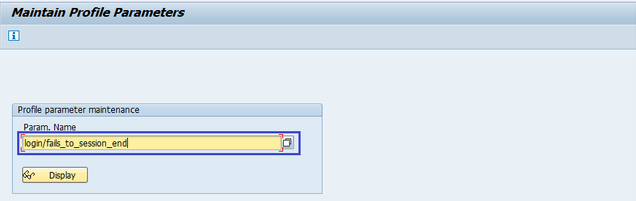
Step2: It navigates to maintain profile parameters
Step3: Enter the parameter name login/fails to session end and click on display
Step4: It navigates to the display profile parameter attributes screen. Current value highlighted below shows the max number of invalid login attempts.
Incorrect login parameters:
Login/fails to session end:
  • Specifies the number of unsuccessful logon attempts
  • The system does not allow any more logon attempts
  • The parameter set to be a value lower than the login/fails to user lock value
  • Default value is 3
  • The allowed values are 1 to 99
Login/fails to user locks
  • Specifies the number of unsuccessful logon attempts before the system locks the user
  • The default value is 5
  • The allowed values are 1 to 99
Login/failed user auto unlock
  • Specifies whether user locks due to unsuccessful logon attempts should be automatically removed
  • Default value is 0
  • Allowed values are 0 or 1  
SAP Trainings Online is only the vicinity where you can trade your future on your brilliant career with our SAP Training courses.it is an interactive global training program started by industry experts with an aim to provide quality SAP BASIS training after the entire route you become well certified professional within the market. 
For more training options visit: www.saptrainingsonline.com
Contact: INDIA:+91 9052775398 USA: +13152825809

Tuesday, 14 November 2017

SAP BASIS e-Learning | SAP BASIS User Activities

SAP BASIS administrators control the access to applications by creating users, maintaining the same users. Users can be collected in groups according to the criteria in a company or a department and based on roles they perform in the project. A typical company will have several separate SAP systems running for production, development, testing and SAP BASIS training, and perhaps a high-availability system mirroring production on top of everything else. Admins will have to keep all of these systems updated, optimized and communicating with each other.
Roles can be defined to either users individually or to the user group. Roles define the user’s authorization levels to navigate or access the specific set of functions or crucial applications.
Authorizations are the key building blocks of SAP security system. How to secure SAP system can be learnt from SAP Security training by SAP Trainings Online with best experienced faculty.
Authorization is the known process of assigning designated values to fields present in authorization objects.
Access to all system functionality in SAP is achieved through a compound set of authorizations
If the users do not have the necessary authorizations to perform a certain action in the system, predefined message. You are not authorized is displayed on the status bar of the screen.
User administration includes creating, managing and controlling access to R/3 system, various R/3 user types and its data.
The SAP NW application server (Learn from SAP NetWeaver training) java includes the identity management application for administration of users, groups and roles.
User administration major tasks are:
  • Creating user
  • Locking or unlocking user
  • Deleting user
  • Approving or rejecting users
The below diagram explains how users are connected to the servers:

SAP user types:
There are 5 different types available in SAP system:
  • Communication
  • Dialog
  • Reference
  • Service
  • System
Communication users
  • Users are not allowed / possible to logon using SAP GUI and cannot able to access the data through SAP GUI screens.
  • Users are allowed to change the password if expired using external link.
  • SAP system always checks for the password expiry, initial password and prompts when it requires to change depends on the logon method. Main use of the users is for external RFC calls
  • These users can access the SAP system data through front end or external applications.
Dialog users:
  • Users are allowed to logon using SAP GUI and able to access data through SAP GUI screens
  • System validates the password expiration initial password and multi logons
  • The user can change the password by their own using SAP GUI
  • These users are individual users and individual personalized system access allowed.
  • Reference users:
  • Users are not allowed to logon using SAP GUI and cannot able to access the data through SAP GUI screens.
  • System doesn’t check for initial password and password expiration.
  • Users for general, non person related which allows the assignment of additional authorizations to the users like internet users.
  • These users used to give authorization to other users.
Service users:
  • Users are allowed to logon using SAP GUI and can able to access the data through SAP GUI screens
  • System doesn’t check for initial password and password expiration.
  • Multiple logins are allowed for this kind of users
  • Users are not allowed to change the password and only administrator can change the password.
  • These users have very restricted authorizations
  • These types of users are created for anonymous users.
  • After an individual authentication, an anonymous session begin with service user can be continued as a person related session with a dialog user.
System users:
  • Users are not allowed to logon using SAP GUI and can able to access the data through SAP GUI screens.
  • System doesn’t check for initial password and password expiration.
  • Users are related system related and internal system processes.
  • The password change requirement does not apply to these user’s passwords and it cannot be initial or expired.
  • Only user administrator can change the password and multiple logons are permissible.
  • These users are for background processing, external and internal RFC calls.
How to learn SAP BASIS?
SAP Trainings Online is a deceptively simple e-learning and SAP training authoring solution. Create super-effective training content and deliver courses via Virtual and implant in existing systems. It is very important for BASIS consultant to have hands on experience on live servers. It is right to have training because every scenario could not be created just by installing SAP. We provide training in many countries India, USA, UK, Canada, Australia, and New Zealand.
Register with us for free demo: www.saptrainingsonline.com/student-registration
For more details visit: www.saptrainingsonline.com
Email: contact@saptrainingsonline.com
Contact: India +91 9052775398 USA +1315282580

Friday, 10 November 2017

SAP BASIS Online Training | Career opportunities with SAP BASIS

SAP BASIS refers to the administration of SAP system that includes activities like installation and configuration, load balancing, and performance of SAP applications running on Java stack and SAP ABAP. This includes the maintenance of different services related to database, operating system, application and web servers in SAP system landscape and stopping and starting the system.
The key responsibilities of SAP Basis Administrator include:
  • System installation and Configuration
  • Load balancing on servers
  • Performance management of different components
  • Managing interfaces and integration with servers
  • Managing servers and different services
With the help of SAP BASIS, different SAP modules like Finance Accounting, Production Planning, Sales and Distribution (Learn what sales deals with in SAP from SAP SD training by experts), SAP EWM and other modules can integrate and communicate with each other.

SAP Basis supports the installation and configuration of SAP applications on different operating systems like Windows, Unix, AS/400, etc. and different databases like SQL Server (want to learn from experts register for SQL Server training), Oracle, IBM DB2 for back end database.
Knowledge required to become SAP BASIS Consultant
Have a strong technical background (and I mean STRONG) as you be expected to know UNIX, AIX, LINUX, WINDOWS, ORACLE, MSSQL, DB2/DB6, JAVA, and all the combination in between them. Also you should know your HARDWARE really well and you need to be skilled on NETWORKING, switching and routing.
Scope of SAP BASIS Consultants in IT organization
SAP consultants who design, build and manage the SAP environment are termed as BASIS consultants. They are the SAP Technical architects in the IT organization.
SAP consultants possess the skills required to administer and configure SAP specific settings in an IT landscape. They are part of a larger organization which may run a landscape consisting of several SAP and Non-SAP applications.
Prerequisites to start career in SAP BASIS
Basic knowledge of operating system administration, network management and database administration.
With Reference to above Diagram SAP Developers and Basis Consultant are the base for SAP support framework.They provide support to functional consultant SD, MM, etc. Functional consultants provide support to business organization like Sales, purchase, finance and HR. And business organization finally provide support to end users. SAP Trainings online is the only vicinity where you can trade your future on your brilliant career with our SAP training courses. It is an interactive global training podium started by proven industry experts with an aim to provide quality SAP BASIS training. After entirety of the route you become well certified professional within the market. There are lot of scholar are licensed with our training course. 
Want  a free demo with us just CLICK HERE 
For more training options visit: www.saptrainingsonline.com
Email: contact@saptrainingsonline.com
Contact: India +91 9052775398 USA +13152825809


Wednesday, 8 November 2017

SAP BASIS Online Training | SAP ERP Introduction

SAP is the world leader in enterprise applications in terms of software and software-related service revenue. Based on market capitalization, it is the world’s third largest independent software manufacturer supporting all sizes of industries helping them to operate profitability, grow sustainably and stay ahead of the competition in the market.
What is ERP?
Enterprise Resource Planning (ERP) is a software that is built to organizations belonging to different industrial sectors, regardless of their size and strength.
If you are new to SAP and want to take SAP BASIS training online course, join SAP Trainings Online.
The ERP package is designed to support and integrate almost every functional area of a business process such as procurement of goods and services, sale and distribution, finance, accountings, human resource, manufacturing, production planning, logistics & warehouse management.
Business process integration
Every business, regardless of the industry they belong to, require connected systems with efficient information flow from one business process to another. Business Process Integration (BPI) plays an important role in overcoming integrating challenges that allows organizations to connect systems internally and externally.
Business Process Integration (BPI) allows:
  • Automation of business processes,
  • Integration of systems and services,
  • Secure sharing of data across numerous applications, and
  • Automation of management, operational, and supporting process.
The following illustration shows an overview of various business processes running in an enterprise and how they are integrated.
Evolution of ERP
During early phases of development, integrated solutions were designed for particular process areas such as:
Material Management − the integrated system was known as Material Requirement Planning (MRP)
Manufacturing − the integrated system was known as Manufacturing Resource Planning
However none of the integrated systems came with a complete solution for an organization covering major business process areas. In early 1990’s, the Gartner Group first used the acronym ERP. By mid–1990’s, ERP systems addressed all the core enterprise functions.
Functions of ERP
An ERP system typically performs the following functions:
  • Supports the integrated business process inside the organization.
  • Improves capital planning and helps in executing organizational plans and strategies.
  • Helps speed up the decision-making process over the analysis of accurate data.
  • Helps extend the business network to wider domains, expanding the products and services to reach more customers, suppliers, and partners.
  • Identifies operational risks to improve governance.
  • Provides protection against organizational data breaches and security threats to leakage of information.
  • Makes the organization adaptable to the rapid changes in the business process according to the needs.
  • Gives long-term profit by providing means to increase the customer base.
Functional areas
ERP is a business management software is usually a suite of integrated applications that a company can use to collect, store, manage, and interpret data from many functional areas including:
Financial Accounting − Deals with financial transactions and data.
Human Resource − Deals with information related to employee of an organization.
Customer Relationship Management − Deals with capturing and managing customer’s relationship, facilitating the use of customer experience to evaluate the knowledge database.
Sales and Distribution − Deals with order placement, delivery, shipment and invoicing.
Logistics and Warehouse Management − Deals with storage of products and shipment.
Manufacturing and Material Management − Deals with the production and production planning activities.
Supply Change Management − Deals with the movement of products, storing, managing, and controlling supplies.
Advantages of ERP
By integrating the business processes, the ERP offers the following advantages:
  • Saves time and expenses.
  • Allows faster decision-making by the management, utilizing the data and reporting tools designed in the systems.
  • Single data source and sharing of data among all the units of an organization.
  • Helps in tracking every transaction that takes place in an organization, from starting till end.
  • Provides synchronized information transfer in between different functional areas such as sales, marketing, finance, manufacturing, human resource, logistics, etc.
Disadvantages of ERP
It is not always easy to incorporate ERP in an organization. ERP suffers from the following drawbacks:
  • Sometimes business processes critical to an organization are to be re-engineered to align them with an ERP solution.
  • Cost of complex integration can be very high.
  • Switching from one ERP solution to another increases the implementation cost even further.
  • End-users are to be trained for their daily operations.
  • Customization is not preferred.
ERP Packages
Many companies develop and implement various ERP packages according to their budget and requirements to help them meet their business needs and run their business efficiently.
SAP Trainings Online is a unique SAP training platform which provides learners with real time project and case studies included in course content. SAP Trainings Online designed SAP BASIS training program based on present day industry requirements which makes the learners future ready and strengthens you to go challenging with industrial demands. We provide training in many countries India, USA, UK, Canada, Australia, New Zealand.
Register with us for free demo: www.saptrainingsonline.com/student-registration
For more details visit: www.saptrainingsonline.com
Email: contact@saptrainingsonline.com
Contact: India +91 9052775398 USA +13152825809

Tuesday, 7 November 2017

SAP BASIS Training | SAP BASIS – Remote Function Call

What is RFC?
For business applications, it is necessary to communicate and exchange information (in pre-defined formats) with other systems. Hence, there are well defined mechanisms to enable this communication. SAP has also provided us with such mechanism called RFC, which stands for 'Remote Function Call'.
To communicate between SAP systems, there is a need to define a mechanism. One of the most common ways is to define Remote Function Call (RFC Connection) between two systems. By creating a trusted RFC connection between two systems, it allows you to create trusted-trusting relationship between systems wherein, you can communicate and exchange information and data.
There are different types of trusted RFC connections.
  • A calling interface for ABAP Programs (See SAP ABAP training for more info about ABAP)
  • A calling interface for Non-SAP programs.
Basis is a set of programs and tools that act as an interface with Database, Operating system, Communication protocols and business applications (such as FI, CO, MM, etc). Full form of BASIS is "Business Application Software Integrated solution". (Develop career with SAP BASIS training by experts).
Functions of the RFC interface:
Converting all parameter data to the representation needed in the remote system.
Calling the communication routines needed to talk to the remote system.
Handling communications errors, and notifying the caller, if desired (using EXCEPTIONS parameter of the CALL FUNCTION).
RFC is a SAP protocol to handle communications between systems to simplify the related programming. It is the process of calling a function module which is residing on a different machine from the caller program. RFCs can be used to call a different program on the same machine as well, but usually, it is used when 'calling' and 'called' function modules/ programs are running on separate machines.
Details about RFC
  • SAP Uses CPIC (Common Programming Interface for Communication) Protocol to transfer data between Systems. It is SAP Specific protocol. Remote Function Call (RFC) is a communications interface based on CPI-C, but with more functions and easier for application programmers to use.
  • RFC connections can always be used across the entire system. This means that an RFC connection you have defined in client 000 can also be used from client 100 (without any difference).
  • RFC is the protocol for calling special subroutines (function modules) over the network. Function modules are comparable with C functions or PASCAL procedures. They have a defined interface through which data, tables and return codes can be exchanged. Function modules are managed in the R/3 System in their own function library, called the Function Builder.
  • You maintain the parameters for RFC connections using transaction SM59. The R/3 System is also delivered with an RFC-SDK (Software Development Kit) that uses extensive C libraries to allow external programs to be connected to the R/3 System.
  • The only difference between a remote call of a function module to another server and a local call is a special parameter (destination) that specifies the target server on which the program is to be executed.
RFC Advantages
RFC helps to reduce the efforts of programmers, by letting them avoid the re-development of modules and methods at remote systems. It is capable enough to:
  • Convert the data into the format understandable by the remote (target) system.
  • Convert the data into the format understandable by the remote (target) system.
  • Call up certain routines which are necessary to start communication with the remote system.
  • Handle errors that might occur in the process of communication.
Types of RFC
Synchronous
Requires both the systems (client and server) to be available at the time of communication or data transfer. It is the most common type and is required when the result is required immediately after the execution of sRFC.
sRFC is a means of communication between systems where acknowledgments are required. The resources of the Source System wait on the target system and ensure that they deliver the message/data with ACKD. The Data is consistent and reliable for communication.
Used for
For communication between systems
For communication between SAP Web Application Server to SAP GUI
Asynchronous
It is communication between systems where acknowledgments are not required (it is similar to postcard delivery).It doesn't require both the systems to be available at the time of execution and the result is not immediately required to be sent back to the calling system.
The Source System resource does not wait for the target system as they deliver the message/data without waiting for any acknowledgment. It is not reliable for communication since data may be lost if the target system is not available.
Used for
For communication between systems
For parallel processing
Transactional
It is a special form of aRFC. Transactional RFC ensures transaction-like handling of processing steps that were originally autonomous. Transactional RFC is an asynchronous communication method that executes the called function module in the RFC server only once, even if the data is sent multiple times due to some network issue. The remote system need not be available at the time when the RFC client program is executing a tRFC. The tRFC component stores the called RFC function, together with the corresponding data, in the SAP database under a unique transaction ID (TID). tRFC is similar to aRFC as it does not wait at the target system (Similar to a registered post). If the system is not available, it will write the Data into aRFC Tables with a transaction ID (SM58) which is picked by the scheduler RSARFCSE (which runs for every 60 seconds).
Interested to learn SAP BASIS join, SAP Trainings Online is a deceptively simple e-learning and course authoring solution. Create super-effective training content and deliver courses via Virtual and implant in existing systems.
Try SAP BASIS Demo Class today! To register Click Here
For more details visit: www.saptrainingsonline.com
Email: contact@saptrainingsonline.com
Contact: India +91 9052775398 USA +13152825809 

Monday, 6 November 2017

Learn SAP BASIS Online | SAP BASIS – New Dimensional Product

SAP Basis refers to the administration of SAP system that includes activities like installation and configuration, load balancing, and performance of SAP applications running on Java stack and SAP ABAP. This includes the maintenance of different services related to database, operating system, application and web servers in SAP system landscape and stopping and starting the system.
Introduction to BI/BW
SAP BI/BW is a data warehousing product and is based on SAP ABAP infrastructure. It is used to convert raw data into reports. This can also be used to build analytical reports and for decision making by business managers.
Using a Business Warehouse, you can combine data from different heterogeneous sources, organize and manage the data for detailed reporting.
This data warehousing product can easily be integrated with different SAP reporting tools. This product can help to analyze multidimensional data from different sources.
The key components in SAP NetWeaver Business Intelligence are:
  • SAP NetWeaver Business Warehouse (see SAP BW training for details)
  • SAP Business Explorer (SAP BEx) and
  • SAP NetWeaver BW Accelerator (BWA)
Besides replicating data from the source to the SAP NetWeaver BW system, it is also possible to access the source data directly from the SAP NetWeaver BW system using Virtual Providers. The analytic engine provides methods and services for analysis, planning and generic services such as caching and security. 
SAP Business Explorer BEx is used to define how data is displayed. This tool also supports the creation of Excel-based and web-based applications for analysis, planning, and reporting. The BEx applications created with the BEx tools can be integrated into the SAP Enterprise Portal. Integration with SAP Business Objects tools (Learn from SAP BO training by experts) offers further options for analysis and reporting in addition to the standard SAP BEx functions. You can access BI information (like reports, analysis and dashboards) with the SAP Business Objects BI Portal InfoView.
BASIS Integration With ECC
SAP ERP is based on SAP NetWeaver version. For example, SAP ERP 6.0 is based on SAP NetWeaver 7.0. SAP ERP is also based on enhancement packages; for example, ERP 6.0 is based on EHP04 and NetWeaver Enhancement Package — EHP01.
The software components always follow product numbering like SAP HR 6.04 belongs to Enhancement Package 4 for SAP ERP 6.0 and SAP BASIS 7.01 belongs to EHP01 for SAP NetWeaver 7.0.
Likewise,
  • SAP ECC 6.0 Enhancement Package 5 is based on SAP NetWeaver 7.0 Enhancement Package 02
  • ECC 6.0 Enhancement Package 4 is based on SAP NetWeaver 7.0 Enhancement Package 01
  • ECC 6.0 Enhancement Package 6 is based on SAP NetWeaver 7.0 Enhancement Package 03
Implementation of an EHP for ECC involves the application of SAP NetWeaver EHP (starting with ECC EHP 4).
SAP Trainings Online is a unique SAP training platform which provides learners with real time project and case studies included in course content. SAP Trainings Online designed SAP BASIS training program based on present day industry requirements which makes the learners future ready and strengthens you to go challenging with industrial demands. We provide training in many countries India, USA, UK, Canada, Australia, New Zealand.
Register with us for free demo: www.saptrainingsonline.com/student-registration
For more details visit: www.saptrainingsonline.com
Email: contact@saptrainingsonline.com
Contact: India +91 9052775398 USA +13152825809